Skip to content


Whether you’re a homeowner aiming to reduce your energy bills or a business exploring commercial solar solutions, you’ll probably have realised that not all solar panels are created equal. The wide variety of panel types on the market is a result of different manufacturing techniques, materials, and technologies, and can be daunting to navigate if you’re not an expert in deciphering the acronyms and specifications that distinguish them.
Our guide is designed to help cut through the complexity, enabling you to select the right type of solar panel for your specific needs, maximise the impact of your investment and achieve your energy goals.
In this 10-minute read, we cover the most common categories – monocrystalline, polycrystalline, and thin-film solar panels – plus advanced and emerging technologies including PERC, bifacial, and perovskite cells. We discuss performance, costs, advantages, and use cases, giving you the insights you need to make an informed decision.
What are the different types of solar panels?
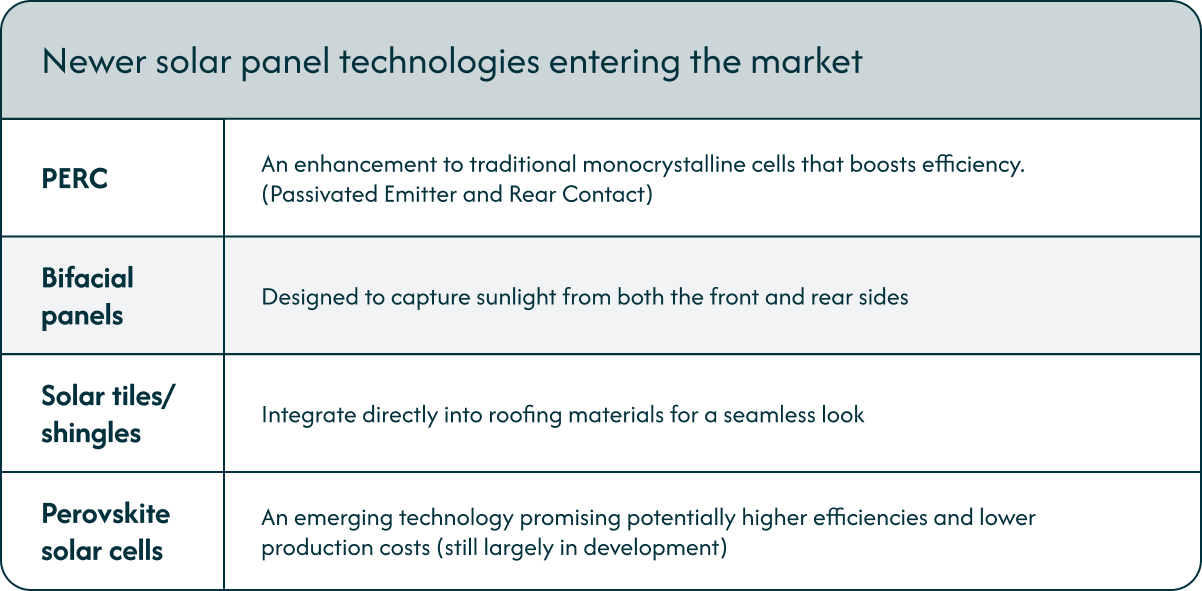
While the technology is constantly evolving, the most commonly available solar panels fall into three main categories. The main differences are the type of silicon used and the manufacturing process.
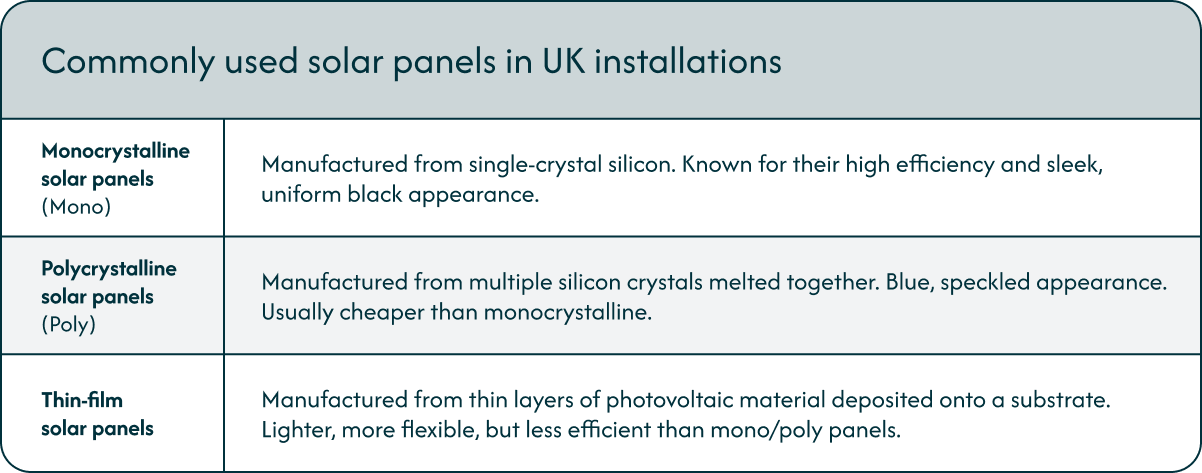
Newer, more specialised technologies are pushing the boundaries of solar panel performance and efficiency, including different solar cell types or form factors.
What are monocrystalline solar panels (mono panels)?
Monocrystalline solar panels, often referred to as ‘mono’ panels, represent one of the most established and efficient types of solar technology available today. They can be recognised by their uniform dark, often black, appearance. Individual cells have rounded or cut corners.
Manufacturing
These panels are manufactured using high-purity silicon. The process involves growing a single, large silicon crystal (known as an ingot), which is then sliced into thin wafers. These wafers form the basis of the individual solar cells within the panel. Because the crystal structure is uniform and unbroken, electrons have more room to move, which contributes directly to the panel’s higher efficiency.
Efficiency
Modern mono panels typically achieve efficiencies ranging from 18% to over 24% (the highest among commonly available panel types). Technologies like PERC can push these efficiency levels even higher.
Performance
This high efficiency makes monocrystalline panels a great choice where space is limited or energy demands are high. They’re also extremely consistent, performing well across various light conditions, and suffer less of an efficiency drop in high temperatures than polycrystalline panels.
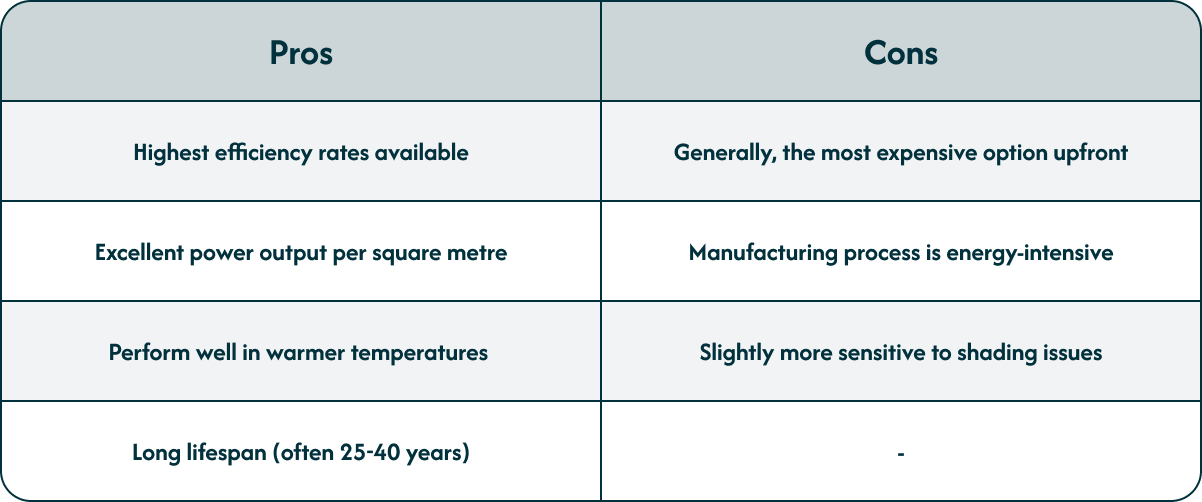
Pros and cons at a glance: Monocrystalline solar panels
Ideal use cases
Polycrystalline solar panels are best suited for:
- Budget/cost-sensitive projects.
- Projects with ample space
- Projects where aesthetics are less critical
- Large-scale installations
What are thin-film solar panels?
Thin-film solar panels are created by depositing one or extremely thin layers of photovoltaic material onto a substrate, such as glass, plastic, or metal, often just micrometres thick. One of the standout features of thin-film panels is their flexibility and light weight.
This opens up applications beyond traditional rooftop installations. They can be integrated into building materials (BIPV – Building Integrated Photovoltaics), applied to curved surfaces, or used in portable solar devices like camping gear or mobile chargers.
There are several different thin-film materials on the market or in development, each with its own pros and cons. Here’s an overview of the main types you’ll encounter in 2025.
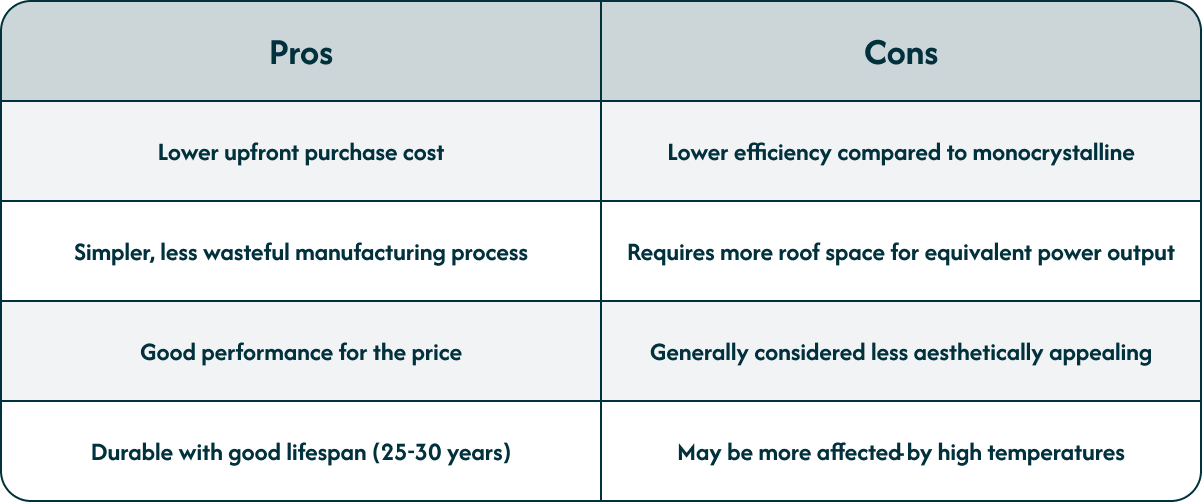
Thin-film panels generally have lower efficiency rates compared to crystalline silicon panels, typically ranging from 7% to 13%, making them less suitable for space-constrained rooftops. And, while they perform slightly better in diffuse light (cloudy conditions) and their efficiency is impacted less by high temperatures than crystalline panels, their overall lifespan is often shorter, with manufacturers offering warranties of around 10-20 years.
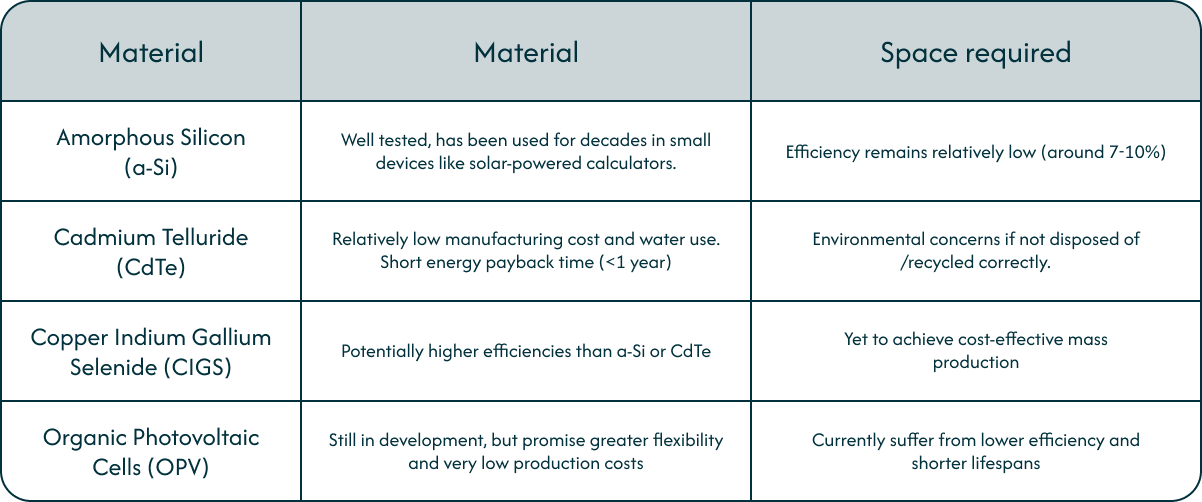
Pros and cons at a glance: Thin film solar panels
Ideal use cases
Thin-film solar panels are best suited for:
- Large-scale commercial or industrial rooftops
- Utility-scale solar farms
- Building Integrated Photovoltaics (BIPV)
- Portable or vehicle applications
- High-temperature environments
Thinking about solar panels for your business?
Our 2025 guide to commercial solar energy in the UK has all the up-to-date information you need on commercial solar panel installation, operation, maintenance and financing.
What different types of solar panels are emerging?
While the monocrystalline, polycrystalline, and thin-film panels that we’ve described above are far and away the most commonly encountered types, various advanced technologies are coming to market which offer performance and efficiency improvements and make new applications possible. Here are some key terms to look out for when researching your options:
Bifacial Solar Panels
Bifacial panels, as the name suggests, capture sunlight via both the front and rear surfaces, as opposed to traditional panels, which only absorb light hitting the front. These panels use transparent backsheets or dual-glass designs, allowing them to absorb sunlight reflected off the ground or roof surface behind them – technically referred to as the ‘albedo’.
- One to watch because: Dual absorption can significantly increase energy yield by between 5% and 30%, depending on the installation and underlying surface
- Costs and availability: Bifacial panels currently sit at the premium end of the monocrystalline market, however, the increase in energy generation can quickly offset the increase in panel costs, especially in commercial and utility-scale projects.
PERC Technology (Passivated Emitter and Rear Contact)
PERC is not strictly a type of panel but rather a technological enhancement applied primarily to monocrystalline (and sometimes polycrystalline) cells during manufacturing. It involves adding a dielectric passivation layer to the rear surface of the solar cell.
- One to watch because: This extra layer reflects unabsorbed light back through the silicon cell, giving it a second chance for absorption, thus increasing efficiency to over 20%, and also boosts performance in low-light conditions and higher temperatures.
- Costs and availability: PERC is already a widely available feature in many mid-range to high-end monocrystalline panels and doesn’t add significantly to the cost compared to non-PERC monocrystalline panels.
Perovskite Solar Cells
Perovskite represents one of the most exciting developments in solar panel technology. Perovskites (a class of materials similar to CaTiO₃) have a specific crystal structure which absorbs different parts of the light spectrum than silicon, potentially leading to much higher efficiencies when used in combination.
- Efficiency for perovskite-silicon cells has already surpassed 33% in lab conditions, significantly higher than silicon alone. They also promise lower manufacturing costs due to simpler processes and less material usage.
- Costs and availability: Perovskite solar panels are not yet widely available for residential or commercial installations. They are anticipated to enter mass market production in the next 1 to 3 years.
Which solar panel type is right for my business?
There’s no single “best” choice of solar panel; the ideal type depends on your individual situation: priorities, budget, property characteristics, and energy goals. However, here’s a rundown of the key factors you should be looking at while considering different types of solar panels:
Budget
How much are you planning to invest upfront? Polycrystalline panels typically have the lowest initial cost per panel, whereas higher-efficiency monocrystalline panels come with a higher price tag. Adding in advanced features like PERC or bifacial capabilities can push the cost up further. However, it’s important to consider the long-term value (cost per watt generated over the system’s lifespan), not just the initial price tag.
Available space
Space is a key constraint and will determine the overall power output you can achieve. Where space is limited – for example, on residential or smaller commercial premises, you’ll want to opt for high-efficiency panels to maximise output: monocrystalline panels being the best option. If you have ample roof or ground space available and you’re prepared to trade off efficiency for lower upfront costs, then polycrystalline or even thin-film panels might be the best way forward.
Energy needs & efficiency goals
How much electricity do you need to generate? If you have high energy consumption or want to maximise your solar production (perhaps for EV charging or future needs), higher efficiency monocrystalline panels are generally preferred. If your energy needs are more modest, polycrystalline panels might suffice.
Aesthetics
Is appearance important to you? If so, monocrystalline panels are a popular choice for their uniform and sleek black look. Thin-film panels are another option, particularly those types which offer integration options (BIPV – explained above). Polycrystalline panels have a more noticeable blue, marbled appearance – but for projects where appearance is less of an issue, they provide a more affordable solution.
Climate and conditions
While most modern panels perform well in various conditions, monocrystalline panels (especially those featuring PERC) tend to handle high temperatures slightly better than polycrystalline. In extremely hot climates or areas with frequent cloud cover, thin-film panels may be the more effective panel type, albeit with lower overall efficiency. And if your installation site has a reflective surface, bifacial panels are ideal, capturing additional light over the same surface area.
Climate and conditions
While most modern panels perform well in various conditions, monocrystalline panels (especially those featuring PERC) tend to handle high temperatures slightly better than polycrystalline. In extremely hot climates or areas with frequent cloud cover, thin-film panels may be the more effective panel type, albeit with lower overall efficiency. And if your installation site has a reflective surface, bifacial panels are ideal, capturing additional light over the same surface area.
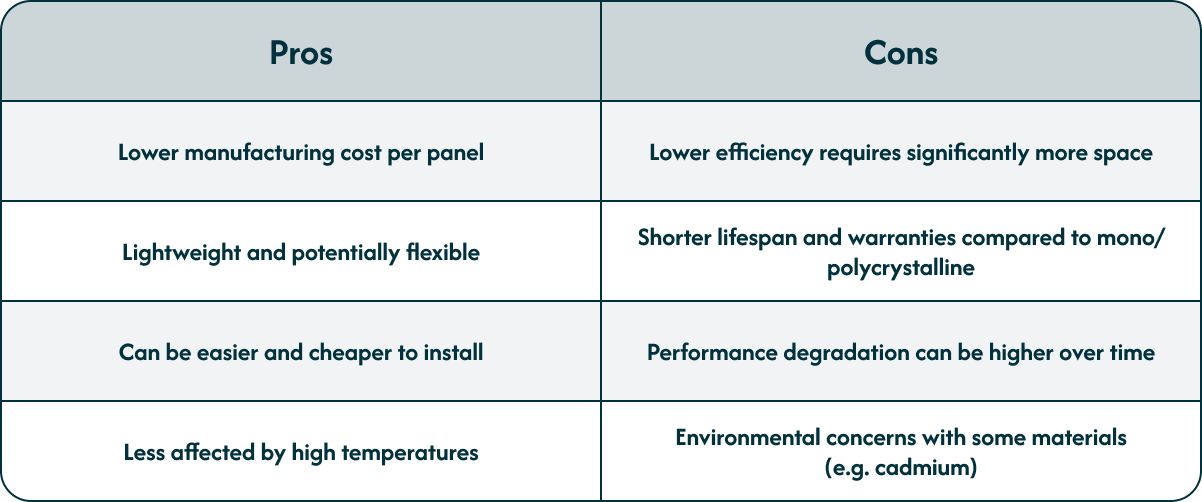
Quick reference guide:
Which types of solar panels last the longest?
Monocrystalline and polycrystalline solar panels are known for their durability and long lifespans. Most manufacturers offer a 25-year warranty, guaranteeing the panels will still produce a significant percentage (usually 80-85%) of their original output after 25 years. In reality, many panels continue to function for 30 years or more, although efficiency will gradually drop off. Warranties on thin-film panels are generally shorter, between 10 and 20 years, depending on the specific technology and brand.
What’s the difference between solar panel efficiency and output?
In simple terms, efficiency tells you how good the panel is at converting sunlight to electrical energy, while output tells you the total power the panel can generate.
Efficiency is measured as a percentage, representing how effectively a panel converts the sunlight hitting its surface into usable DC electricity. For example, a panel with a 20% efficiency rating converts 20% of the solar energy it receives into usable electricity.
Output is measured in watts (W) and refers to the total amount of electrical power the panel produces (under standard test conditions), determined by multiplying the panel’s efficiency by its surface area and the amount of sunlight received. Common panel outputs are between 250 W and 400 W. /p>
Are new solar panel technologies worth the investment?
This depends on the specific technology and your goals. Technologies like PERC are now standard in most modern monocrystalline panels. They offer proven efficiency gains with little to no extra cost compared to older non-PERC designs, making them a worthwhile choice. Bifacial panels can be a sensible investment if your site allows for significant light reflection onto the back of the panels, as the added energy yield (which can be as much as 30%) can offset the slightly higher panel cost.
Investing in emerging technologies, like Perovskite panels, which are still in the research and development stage (although already commercially available), carries more risk. While there will most likely be significant future breakthroughs in efficiency and cost, early adopters face higher prices, potential unforeseen issues, and limited performance data in real-world installations.
Can you mix different types of solar panels?
Investing in emerging technologies, like Perovskite panels, which are still in the research and development stage (although already commercially available), carries more risk. While there will most likely be significant future breakthroughs in efficiency and cost, early adopters face higher prices, potential unforeseen issues, and limited performance data in real-world installations.
Using microinverters can mitigate these issues to some extent, as each panel operates more independently. However, installers still prefer using uniform panels for consistency and easier system design. Different panel types also degrade at different rates, further complicating long-term performance and warranties.
Choosing the right type of solar panel for your business
At JLM, our expertise lies in ensuring your investment in solar energy generation is optimised for sustained energy production and financial return, not just for short-term savings. As a first step, we offer a free remote audit to discuss your objectives and accurately identify the right solar panels for your needs.
During the audit, we’ll discuss the different underlying technologies and their suitability for your energy goals and operational requirements, as well as determine the size or dimensions of your system based on available space. We’ll follow up with a personalised PDF report, including our recommended type of solar panels, along with cost breakdowns, annual savings projections, and a predicted return on investment
Contact one of our expert consultants to book your free audit today.